Monte Carlo Analysis Challenges: Predicting Project Cancellation

Statistically, we know that some projects will never be delivered. Projects are cancelled for a variety of reasons.
Other projects go through multiple reincarnations and deliver after several attempts. Decisions to stop a project, redefine its scope, or change the delivery strategy are common realities of project delivery.
Project analysis methods should be able to predict such possibilities. However, none of the commonly applied methods today can reliably estimate the probability of project cancellation.
There are two primary reasons for this: mathematical and psychological.
The Mathematical Challenge
A strong candidate for predicting project cancellation is Monte Carlo Simulation (MCS).
However, this would require a fundamental shift in how MCS is typically applied.
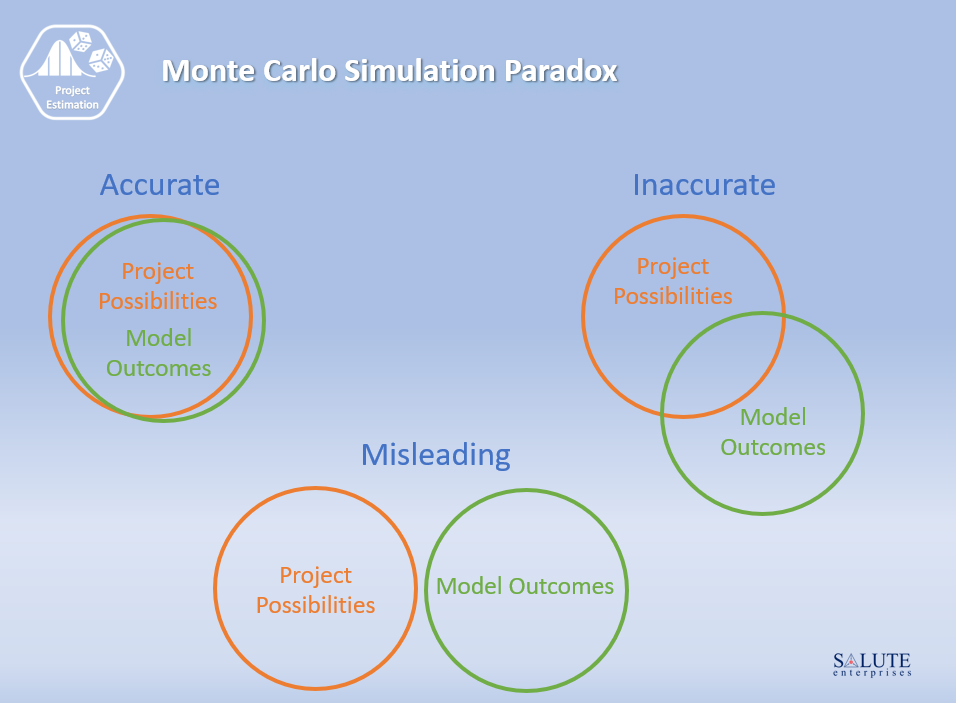
MCS generates thousands of possible project outcomes. In theory, a properly designed simulation model considers all possible outcomes, not just the outcomes that lead to project completion. In practice, this is rarely the case.
If project cancellation is a possible outcome, the simulation model should explicitly include a “project cancelled” scenario. This would allow analysts to estimate the probability of cancellation alongside the probability distribution of delivery dates, costs, and benefits for projects that are successfully completed.
Without modelling cancellation as a valid outcome, the simulation can’t predict it, regardless of how sophisticated the analysis may appear.
The Psychological Challenge
The second challenge is the quality of the simulation model itself.
Project teams, sponsors, and organisations are often reluctant to acknowledge the possibility of project cancellation. As a result, forecasting models are designed to answer the question:
“When will the project finish?”
rather than the more fundamental question:
“Will the project finish at all?”
Many projects are cancelled because of risks that are known but never formally documented or analysed. This is not necessarily because project teams fail to recognise them, but because they are too complex, politically sensitive, or difficult to address.
I refer to these as “elephants in the room”— systemic issues that create a significant probability of project failure. If such risks are excluded from the simulation model, the analysis will systematically ignore some of the most important project outcomes.
This creates an optimism bias that removes critical failure scenarios from the analysis before the simulation even begins.
Conclusion
To use Monte Carlo Simulation effectively for project forecasting, we must move beyond estimating delivery dates and costs. Simulation models should explicitly represent cancellation and major scope changes as legitimate outcomes.
At the same time, organisations must be willing to acknowledge systemic risks and understand how they impact project outcomes.
Only then can Monte Carlo Simulation can provide a realistic view of project uncertainty, including the possibility that the project may never be delivered at all.

Alex Lyaschenko
PMO | Portfolio Planning & Delivery | PMP | P3O Practitioner | AgilePM Practitioner | Six Sigma